18 November 2011

__________Cummings:____________"next to of course god america i


E. E. Cummings


"next to of course god america i
love you land of the pilgrims' and so forth oh
say can you see by the dawn's early my
country 'tis of centuries come and go
and are no more what of it we should worry
in every language even deafanddumb
thy sons acclaim your glorious name by gorry
by jingo by gee by gosh by gum
why talk of beauty what could be more beaut-
iful than these heroic happy dead
who rushed like lions to the roaring slaughter
they did not stop to think they died instead
then shall the voice of liberty be mute?"
 
He spoke. And drank rapidly a glass of water

____________________________________

Why I love this poem by E. E. Cummings:  (and yes, I capitalized his name on purpose.  It is hip to do so these days, apparently.   For a lengthy discussion as to why, see here:)

  •  It's a brilliant little character sketch done nearly entirely with dialogue.
  • It skewers simpleminded patriotism & criminally confused political rhetoric.
  • (Most astonishingly): It is a sonnet.  Look:  14 lines, and those end rhymes!  abab/cdcd/efg/feg.  Wow!
I remembered this little satirical gem while writing a blogpiece about my habit of memorizing poetry.  Watch this space for that one soon!
For compounded delight:
Hear the poet read his poem, here!

21 August 2011

"Would You Believe. . .?": For "Get Smart" Fans Only!


Many Friday nights these weeks you will find me down at my stepmother Amy's place, sitting with her on the couch and enjoying Channel 3's reruns of "Get Smart."

The show, which was utterly hilarious to me and my brothers as kids in the 1960s, is still pretty funny.

If you weren't watching the show back in its original run, between 1965 and 1969, it is hard to communicate its wacky cultural impact.  The catchphrases and comic tropes and ridiculous gadgets featured in the spy spoof were a part of everyday life.  Every fan knew about the Cone of Silence, the invisible wall and the falling net in Max's apartment.  Even non-watchers might know about the Shoe Phone.  Most kids wanted one. I sure did. 

A huge amount of the show's charm and success came from Don Adams' portrayal of the bungling Agent 86, Maxwell Smart of CONTROL.  Smart was, in a word, not.  But he thought he was.  He was sure he was in control and slick and attractive to women.  No matter how many times he failed--and he managed to bungle everything he attempted--he always managed to get up, brush off his lapels, and utter some priceless line with his usual barely-shaken aplomb.  

It is hard to imagine the character played by anyone but the amazing Don Adams.  Adams brought just the right note to Maxwell Smart, so we could laugh at his consistent remarkable ineptitude as well as his unflagging braggadocio and still find him charming, not overbearing.  He was brilliantly teamed with beautiful Barbara Feldon as Agent 99 (just a notch less than a perfect 100), whose support and love and help for her partner went a long way to help us tolerate and even root for him as well.

It is no surprise, then, that most of the show's memorable catchphrases were lines spoken by Maxwell Smart.  Adams gave them a hilarious, pretentious flourish that stuck.  At least three of these have become a part of the language.  People still use them, though they may not remember where they came from right off hand:

-"Missed it by THAT much!"
-"Sorry about that, Chief!"
-"Would you believe. . .?"

and I can't resist another:

-"I asked you not to tell me that!"


That is just four of a whole bunch of memorable phrases from the show.  There is a comprehensive list of these, including links to recordings of most, at this astonishingly detailed website.  (It illustrates a credo of mine that we all benefit from other people's obsessions.) 

When I was watching the show as a kid, the names Mel Brooks and Buck Henry meant nothing to me.  Truly, it was only years later, after Young Frankenstein and Blazing Saddles that somebody told me "Get Smart" was a Mel Brooks TV show.  Thinking about it, it made too much sense.

Watching the show now, it is soooo Mel Brooks! His broad, overplayed, childishly hilarious humor infuses the whole thing. Last night's episode featured a couple of KAOS agents who would become continuing characters, Ludwig von Siegfried and Shtarker, two classic Mel Brooks ridiculously excessive Nazi caricatures.  Think "Springtime for Hitler."

The show's opening credit sequence sticks in people's minds.  Its details are the stuff of trivia contests (What color was Agent 86's car?  How many doors does he go through, all told?) and the answers depend on which of the show's 5 seasons you are talking about.  As kids we acted it out over and over and over. 

It is almost hard to remember what made the opening sequence so clever, I've seen it so many times.  What happens in it?  A car pulls up at a curb.  Agent Maxwell Smart jumps out and runs inside one of several different buildings, depending on the season. From here on the action was always the same.

Max is seen going through a series of doors and finally ending up at a phone booth.  But each of the sets of doors is different in some clever way.  The first doors clearly belong to an elevator.  The dial above them reaches zero and the doors draw aside to reveal. . .not an elevator but Agent 86 coming quickly down a long flight of stairs.  

The point of view reverses to follow Max as he walks down a long hall, through the succession of doors.  The first set of heavy, metal, riveted doors swings inward to close with a boom behind him.  He now faces what looks like a blank metal barrier until it splits into doors that slide quickly to each side as Max hurries through.  They boom shut behind him.  Next, a single metal door slides up and closes back down with a clang.  Max is seen walking quickly toward what looks momentarily like prison bars, until they, too, simply painted on panels, split in the middle and slide swiftly apart.

After they close, Max opens the door of a classic old-time telephone booth.  (Don't forget that door when giving your trivia answer!)   He puts a coin in the phone's slot and dials 3 numbers, immediately hangs up the phone and turns around to face us, arms folded.  The music stops and Max disappears, dropping down through the floor of the booth.  A two-note flourish finishes the theme song, underlining his astonishing exit.

After watching this again last night, I thought, "Hm. . .what is it about this that seemed so clever or interesting when we watched it as kids?  Why could we not get enough of watching it, so that we acted it out in the living room as it ran?" Specifically, what was it about those doors?

Well, for one thing, each of the 5 doors had its own trick.  They all looked and opened differently.  That in itself was fun.  

But that couldn't have been the only spark there, I thought.

Then it hit me. What a difference a historical perspective can make!  When "Get Smart" aired, from 1965 through 1969, there was something especially exotic about those sets of doors that Max walks so confidently through:  those doors were clever gadgets of espionage because such doors did not exist in real life at the time, as they do now!  

There were no real-life doors that, somehow magically sensing your presence, slid quickly apart to close as swiftly behind you, as these do!  The only sideways-sliding doors in those days were the stately, slow doors of elevators.  Those could hardly be called "automatic," as you had to press a button to hail the elevator and then wait and wait for them to finally open.  Real life came to imitate art and eventually make such sets of automatic sliding doors a commonplace part of our urbanscape.  It is no surprise that they are still commonly referred to as "Star Trek doors."

As we have all heard, in that show, the doors were operated by stagehands stationed inside the walls who would yank them apart on cue.  Blooper reels where the doors don't open in time, or open crookedly or unevenly as cast members walk right into them are evidence of this.

So the same was true with the "Get Smart doors."  Each set of these was a stage effect, operated on cue by crew members.

The fact that now we watch this sequence without that added note of delight at these clever devices shows how things have changed in 40-plus years.

In some ways, at least, we have caught up to "Get Smart."

Is the Shoe Phone next?

24 July 2011

Ignatz' First Brick - A Krazy Kat Anniversary


 A cat.  A dog.  A mouse. A brick.

From such simple materials George Herriman, a true genius of 20th-century art, fashioned a world of wacky and winsome wonders! 

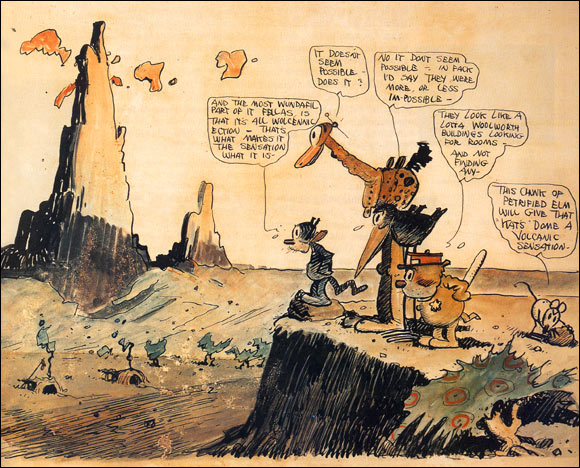
In case you are one of the blissfully uninformed who has yet to discover this multifarious and mystifying realm, I am talking about the delightful and hilarious comic strip Krazy Kat, which ran daily in newspapers from 1913 to 1944.

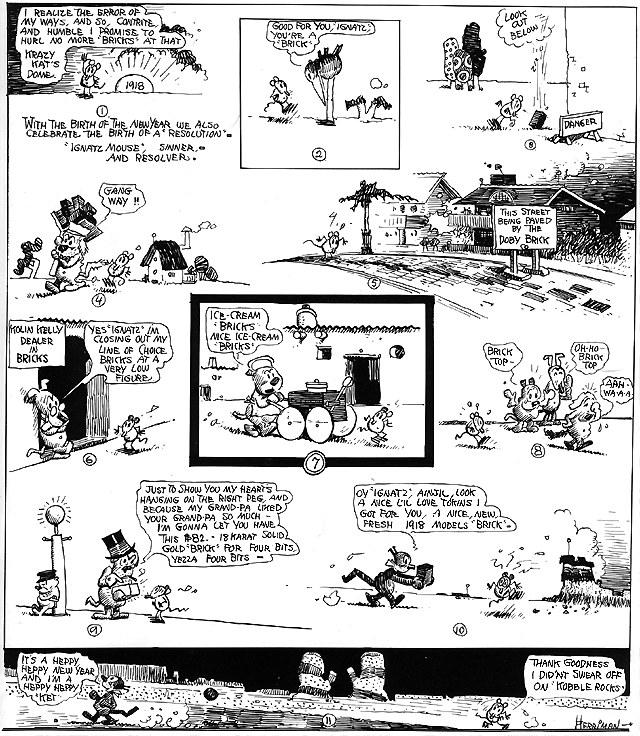
The dramatic structure and conflicts of the strip are easily summarized:  Krazy, a cat (or "Ket" in Krazy's own unique argot) sings, dances and ambles through the world with one thing in mind:  he or she (more on this later!) is hopelessly in love with character #2, Ignatz Mouse.  Ignatz, a cynical iconoclast, does not return Krazy's affection.  What he does return--and deliver--at every opportunity, are bricks, calculated to crease Krazy's benevolent,  adoring noggin.  Krazy knows these masonic missles are adamantine tokens of Ignatz' love, and welcomes them as such.  To complete the eternal triangle enter The Law:  Offisa Bull Pupp.  Pupp's job is to stop Ignatz from firing his bricks at Krazy.   Pupp is secretly in love with Krazy himself.  Krazy seems unaware of his affection.  Krazy just knows that Offisa Pupp frequently lodges her or his unrequited lover in the local jail.  Sometimes Krazy even works to release Ignatz from these confines, consternating the cop.

[A quick note about the strip's seeming pronominal confusion and Krazy's gender is in order:  the strip sometimes refers to the self-described "Heppy Ket" as he/his, sometimes as she/her.  When film director Frank Capra asked Herriman to clear up the issue of Krazy's gender, the cartoonist replied that, after his own soul-searching and experimentation with the character, he realized that "Krazy was something like a sprite, an elf. They have no sex. So that Kat can't be a ‘he’ or a ‘she.’ The Kat's a sprite—a pixie—free to butt into anything. Don't you think so?" This article will treat him or her accordingly.]  

And so it goes.  Eternally, under the surreal sun or wacky moon or sometimes moons of stylized Coconino County.  Kat loves Mouse.  Mouse hates Kat, expressing it with impenetrable projectiles.  Dog cop loves Kat and incarcerates Mouse incessantly.

It is a formula so simple as to be iconic and eternal.

What George Herriman did within the confines of such a simple plot is truly and delightfully miraculous.

  [Click to Enlarge]

The action of Krazy Kat is set in a wildly stylized version of the real Coconino County, Arizona, the country's second-largest county and home to natural wonders like the Grand Canyon and the Painted Desert.  These landforms, through the lens of Herriman's imagination, show up as bizarre and surreal backgrounds to the strip, ever-changing and fascinating.  

Herriman's strip is the perfect blend of exuberantly imaginative visuals, inventive plotting, and idiosyncratic, slangy, alliterative dialogue.  Krazy speaks in a strange dialect, said by some to be a version of Yat, the New Orleans dialect that Herriman himself grew up speaking.  (Krazy:  “Lenguage is that we may mis-unda-stend each udda.”) The dialogue in the strip is sometimes phonetically spelled and ranges from Krazy's unique mixture, sprinkled with Yiddishisms, to the mock-intellectual, wryly poetic pronouncements and descriptions of the strip's narrator ("Officer Pupp, engaged in small talk with 'Krazy Kat,' of this, of that, and why - why is Red Mesa red, and White Mesa white, and why is Black Mesa black - and is it true that the mountains of 'Kaibito' lie down to let the sand dunes crawl over them, and are the Elephant's Feet pink because they wade in Red Lake - --------------- when, alluvasudden -")  [Note:  It looks so much better in Herriman's printed all caps! See original here. - Herm.]

Herriman spun off the Kat-mouse-and-dog eternal triangle from an earlier strip of his called The Dingbat Family, which debuted in 1910Said family was mostly concerned about the noisy hubbub of the never-seen people who lived upstairs. Just as Popeye appeared first as a walk-on sailor in Elzie Segar's strip Thimble Theatre, Krazy and Ignatz first appeared as a cat-and-mouse gag drawn at the bottom of The Dingbat Family panels: Ignatz was the upstairs family's mouse come down to variously antagonize and annoy the Dingbats' cat.  It was Ignatz who described the cat as 'Krazy.'

As these things do, the bottom-of-panel slapstick gag grew by 1913 to be its own, now-titled strip, which, of course, eventually replaced The Dingbat Family.

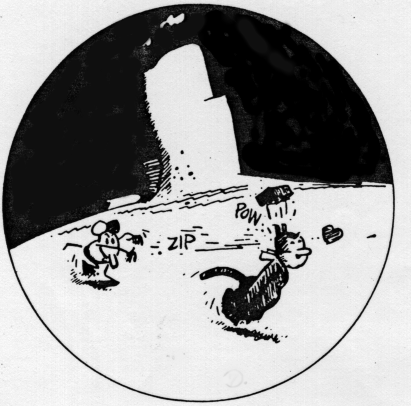
But it was back in 1910, when the cat and the mouse were still just an afterthought doodle  at the bottom of the larger strip, that the historic event took place:  on July 26 of that year, the mouse first threw a brick at the head of the cat!

We commemorate this important happening in our cultural history:  101 years ago within hours of this publishment.  


While the strip met a sometimes puzzled, mixed reception by the public in the 30 years of its daily run, it was then and has since been embraced by intellectuals and artists of all kinds.  The art critic Gilbert Seldes called it "the most amusing and fantastic and satisfactory work of art produced in America today." Poet e.e. cummings wrote a now-famous essay about the strip as the introduction of the first collection of Krazy Kat in book form.  In its time, other big fans of the strip included Willem de Kooning, H.L. Mencken, and Jack Kerouac.

One of the strip's biggest admirers was William Randolph Hearst, in whose New York Evening Journal it first appeared.  Hearst so loved the strip that he gave Herriman a lifetime contract and nearly-complete creative freedom.   We can thank Citizen Hearst for providing an open platform for George Herriman's fertile and wacky imagination.

Since then, the strip has been admired by millions, has been converted into several series of (mostly terrible) animated cartoons, has inspired a jazz ballet (1922) and has influenced many well-known cartoonists, from Charles Schultz and Will Eisner to Patrick McDonnell (Mutts) and, to me most obviously, Bill Watterson's brilliant Calvin and Hobbes.


And so I welcome you to the visual and verbal joys of one of America's great works of art!  If you have never seen Krazy Kat before, you can read more about it here, and explore some galleries of strips here.

Welcome to Coconino County and the joys of Krazy Kat!

[Click to Enlarge]

17 July 2011

Overheard at the Village Inn, 3 AM.

A group of young people was seated next to me just now.

Girl, thumbing her smartphone:  "Do you know that a PhD is a 'Doctor of Philosophy'?"

Boy sitting next to her:  "No!  You mean that's what it means?  No.  What does it mean?"

Girl:  "'Doctor of Philosophy.'  PhD means 'Doctor of Philosophy.'  That's what it means!"

Boy:  "No!  Really?  No!"

16 June 2011

Ramayana: Divine Loophole - Sanjay Patel Colorfully Retells the Indian Epic.


I was prowling the Hinduism section at the Tattered Cover Colfax when I found this delightful new gem.  

Published just last year (2010) by Chronicle Books, it is Ramayana: Divine Loophole, by Sanjay Patel.  Every page of this retelling of the Indian epic is another visually arresting illustration by Patel, who works as an animator and storyboard artist for Pixar Animation Studios.

Patel, though the son of Hindu parents and surrounded by the characters and the story of The Ramayana as a kid, admits that it didn't really sink in or touch his life until he started researching his first book, The Little Book of Hindu Deities (another gem, by the way, this one aimed at children.) That experience spurred him to read a modern, 3000-page novelistic retelling of The Ramayana.  Drawn deeply into the story, he began, for the first time in his life, to appreciate these beloved characters and the epic tale his parents so revered.  

Lucky for us, he decided that his second book would be an illustrated version of the epic.

The Ramayana is one of two ancient Indian epics, and was first written down in the 5th to 4th centuries B.C.  It tells the tale of great blue-skinned hero Rama, an avatar of the god Vishnu, and his battle against the ten-headed demon king Ravana, who has abducted Rama's beautiful wife, Sita.  Ravana has run roughshod over the gods themselves, who foolishly promised him he could never be killed by either god or demon.  But the "divine loophole" of Patel's title is the fact that the gods' promise said nothing about his vulnerability to humans or animals. Since Ravana might therefore be killed by a mortal, preserver god Vishnu decides to be reborn in human form. Enter Rama.

Hanuman wears the image of Rama in his heart.
Rama is assisted in his quest by the great bear chief Jambavan, the monkey king Sugriva, and most notably the white monkey (who has forgotten he is a) god, Hanuman.   These animal chieftans bring along their entire families.  A gigantic army of bears and monkeys gathers to battle against Ravana and his hosts of demons!

Ramayana: Divine Loophole is an excellent retelling of the main points of the epic.  Patel's text is lively and succinct, but the real power, the beauty and joy and wit of this book is in its illustrations.

Far more than just an illustrated book, this is a work whose visual aspect engages, delights and astonishes on nearly every page. In addition to the text, each two-page spread displays a splash of color and a lively, kinetic design carrying the story forward.  In large part, the book tells its story through its pictures, though the narration is good, too, with the punchy spirit of a childeren's book.

Sanjay Patel's work can be witty, exciting, intricate, and so spirited as to be at times cinematic.  There are delightful moments in the book where specific incidents are narrated in the text and you find yourself hunting among an epic illustration with seemingly thousands of characters and details to find--finally!--that incident, now perfectly visible.  Kind of a Where's Rama? experience. 

That is how these colorful, well-composed pictures can seem cinematic.  There is often much more going on than you see at first glance.  Indeed, one of the joys of this book is that you can immerse yourself in these amazing pictures and travel deeper into them the more you look.
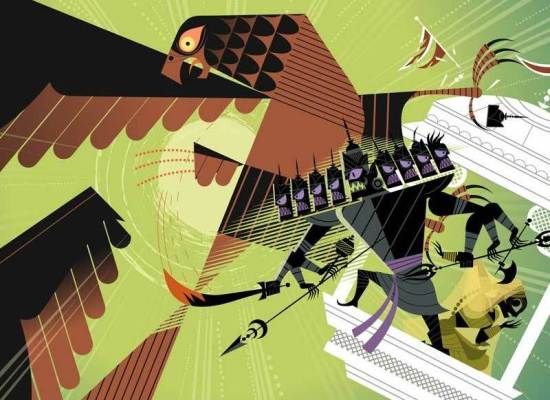
Battle between demon king Ravana and valiant eagle Jatayu
 The moods of Patel's pictures are many.  There is suitable nobility in the depictions of Rama, and great beauty when he is together with his wife, Sita.  The hordes of demons that fill the book are truly hideous, at times really scary.
This is especially true of the depictions of ten-headed Ravana.  All of those heads, snarling, leering, showing rows of jagged, knife-point teeth!  There are fantastically aggressive and intricate battle scenes with hundreds of characters, the sky a bristling storm of arrows! One delightful two-page spread has scores of monkeys cavorting among the branches of an immense tree, while down below a host of their bear brethren gobble up proffered nuts and berries.
In exile in the forest, Sita comes upon a most unusual deer.
  Ramayana:  Divine Loophole is a spirited, worthy introduction to the epic for both adults and children.  I might limit this to children who would not be overly disturbed by the hosts of horrifying demons or the bellicose scenes of decapitation of both good guys and baddies.  But to me, the story is so well-told and the characters so inherently noble and worthy that I can see it becoming a kids' favorite, not despite but rather because of its more lurid aspects.  Kids love that stuff.
Beloved monkey god Hanuman besieged by demons!

This is, in fact, my initiation to the wonders of  the Ramayana, and I found it to be an exciting, compelling, and subtly witty one.  Patel's text as well as his illustrations is always lively and direct and "modern,"  but with a deep respect and honor for the characters and tales of his source material, the epic.

As if retelling this monumental tale wasn't enough, Patel devotes a full 40 pages following it to short descriptions and great illustrations of the story's major characters.  Four sections depict Gods & Sages, Warriors, Animals, and Demons.

And following that are several more pages where Patel shows scores of his original sketch ideas for the characters and incidents in the story.  In accompanying text, he takes us through his process of creation, emphasizing that "Sketching is just another way of thinking and another form of writing." The color drops away here, mostly, and we see his visual ideas evolve through hundreds of individual sketches arrayed on a pure white paper background.  He ends his short explanation by exhorting prospective artists to think through obsessive sketching.

"Keep drawing," he says, "the art will reveal itself.  It's inevitable;  just trust the process."

The Battle of Lanka:  Rama and army face off against the demon hordes.

 The rest of us can be thankful that Sanjay Patel followed his own advice.
 

29 May 2011

"The Birth of the Human Soul"


At one point in his thrilling, eerie new documentary film, Cave of Forgotten Dreams, Werner Herzog is interviewing a genial French scientist on a hillside near the caves of the title.  The camera is on the white-haired scientist, a character we have come to respect and enjoy by this point in the film.  We can hear Herzog's gentle German accent asking questions.  

He comes right out with it, out of the blue:  "So, do you think the findings in this cave show the birth of the human soul?"  

It is clear that Herzog does. He uses the phrase several times in his soft-spoken but disarmingly incisive narration, as he does in interviews about the film:  "the birth of the modern human soul."

While quick to caution us on what "soul" might mean, it is clear that to Herzog it is deeply entwined with humanity's deep impulse for making art, which could be said to be the subject of this utterly hypnotic film.  Herzog's camera is an unblinking eye--or really two eyes, since the film is shot in 3D--that gazes endlessly at the prehistoric cave paintings in Chauvet Cave in southern France. We are looking, quite literally, at the world's oldest human art.  Later that eye is turned on some evocative early sculptures, those "Paleolithic Venuses" we might have seen in books as well as renderings of a mammoth and a horse. But Herzog's camera-eye, combined with stark, sculptural lighting and enhanced by the 3-D effect, infuses these objects with a mysterious power.

All this forges for Herzog, and for us (his deeply-felt testament is powerfully convincing) a direct-line connection between the humans who painted mammoths, horses, panthers, and huge-horned rhinoceros ancestors on the walls of Chauvet Cave, and us with our modern forms of representation.  One interviewee brings the circle closed with a telling gesture at the camera, comparing the desire that created the cave paintings with that of the cameraman capturing his image at that moment.

Though Herzog shows us the paintings on the walls of Chauvet Cave almost from the first moment, the film's power builds slowly through a series of interviews with scientists, images of cave exploration, and always those gently-spoken yet  poignant ruminations of Herzog's voice-over.  What starts off feeling like a run-of-the-mill historical documentary slowly takes us to unexpected places.  By the time, well into the film, that Herzog lets sweeping, continuous images of the cave paintings combine in an extended sequence with haunting music that sounds both perfectly modern and utterly ancient, the effect is deeply moving as to be almost unbearable.

It is magnificent, hypnotic, brilliant filmmaking, that makes its point strongly through images and music.  In an interview, Herzog describes the experience of being in this perfectly-preserved time capsule cavern as  "an almost shocking experience."  Herzog's filmmaking is relentless, piling thought on image on music, compounding and re-emphasizing, to where we, too, are shocked by the depth of the experience.

Herzog has said he is "skeptical" about the use of 3-D in films, yet he had no question about using it in this project.  And it works beautifully, serving to immerse the viewer in the experience of the cave, and visually echo the emotional and intellectual depths Herzog unflinchingly takes us to.

Cave of Forgotten Dreams is a rare treat, taking us to places, both physical and spiritual, that otherwise might have remained closed to us.  Visitors are not regularly allowed in Chauvet Cave.  Herzog and his crew were allowed in on a strict schedule of only 4 hours each day.  They were, perhaps, the last film crew to ever set foot in this deeply important historical wonder.

By seeing this film, we can travel, be awestruck and marvel along with them.


27 May 2011

The Country's In the Very Best of Hands

I woke up this morning thinking of. . .and soon after singing. . .this excellent song from the 1956 Broadway musical Li'l Abner.  

This number is hilarious and brilliant and has not lost one iota of its wry wit and incisive truth.

Listen to these great Johnny Mercer lyrics!!

(This version is from the 1959 film, with Peter Palmer as Li'l Abner Yokum and the great Stubby Kaye as Marryin' Sam.)